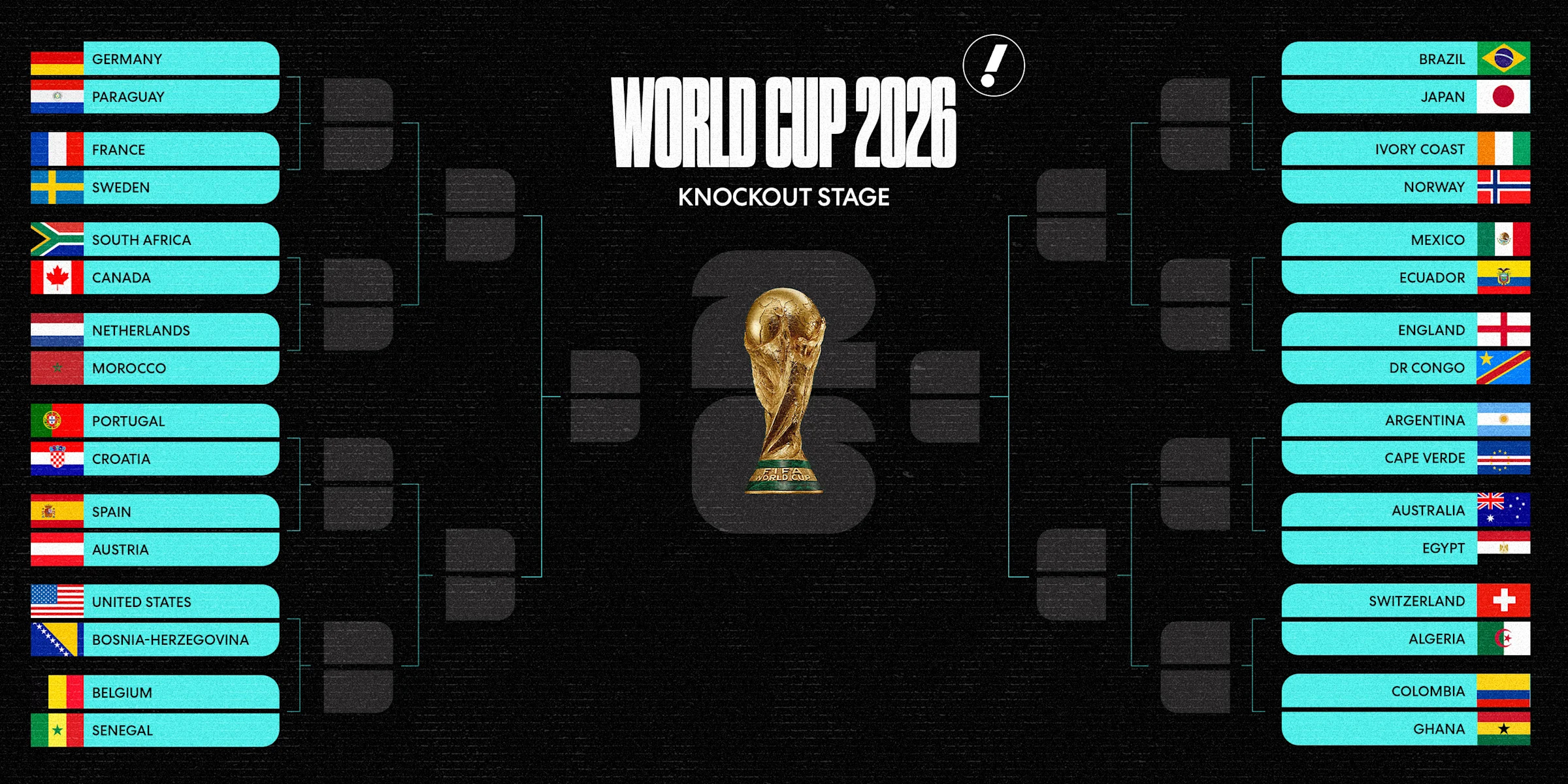
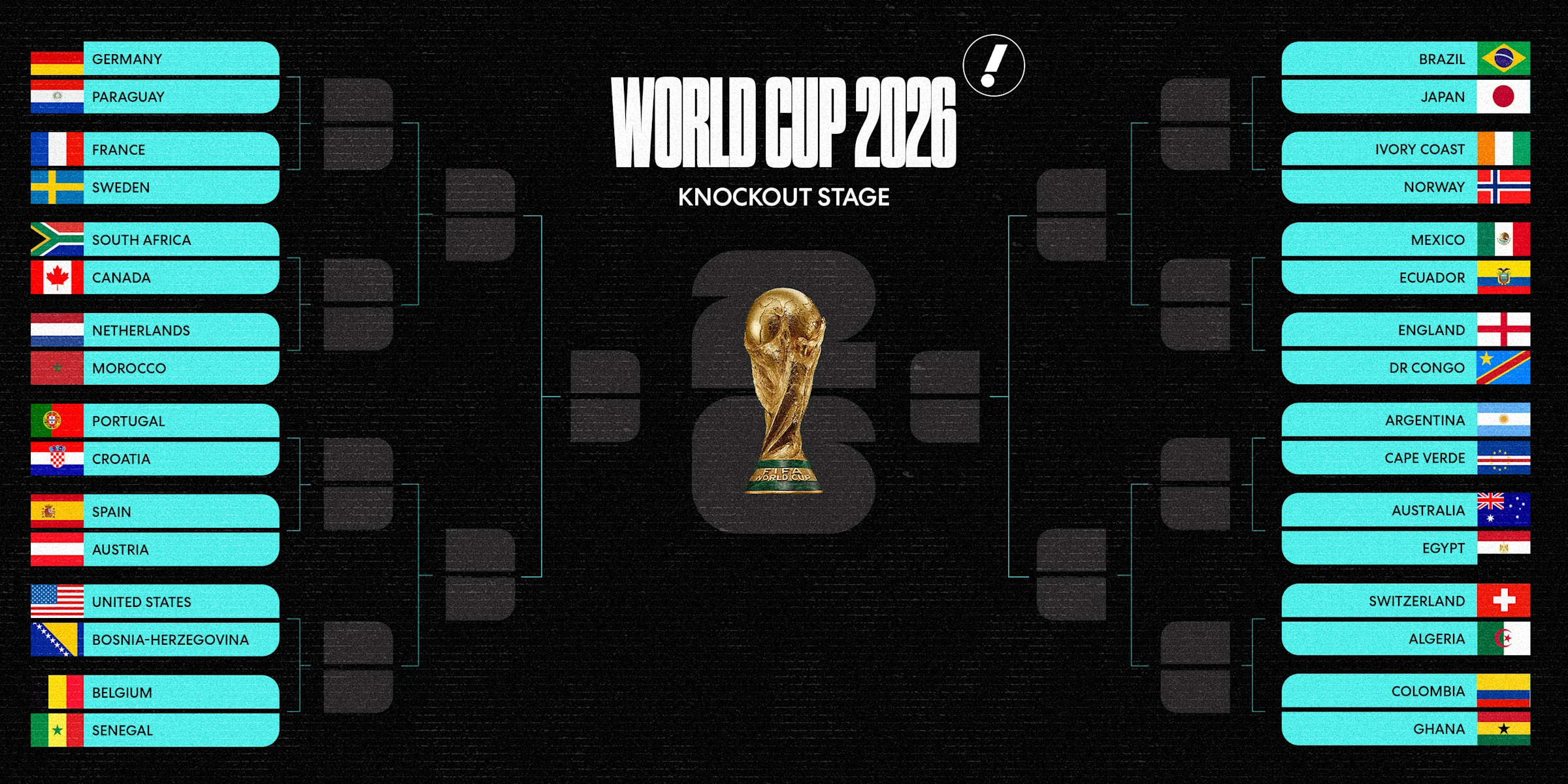
The 2026 World Cup group stage is behind us — and the opening knockout matches have already shown just how much the new 2026 World Cup 48-team format and rules have changed the tournament's mathematics. Today, 29 June (Kyiv time), Brazil, Germany and the Netherlands take to the pitch — three favourites with something to prove after an uneven group stage. We analyse the bracket, form and possible scenarios.
How the 48-Team Format Works at the 2026 World Cup
For the first time in history, 48 national teams competed at the World Cup, split into 12 groups of four. Thirty-two sides advanced to the knockout stage: the top two from each of the 12 groups, plus the eight best third-placed teams. The tournament features a record 104 matches in total. The key innovation is an extra Round of 32 that did not exist in the 32-team format. That round kicked off on 28 June and runs through 4 July.
For more detail on how the knockout stage works after the groups, see our article "2026 World Cup: 48-Team Format — How the Knockout Stage Works After the Groups".
12 Groups of 4: Who Advanced to the Knockout Stage
The group stage threw up several surprises. In Group A, Mexico won convincingly with 9 points, but second place went to South Africa (4 points) — South Korea, despite also having three points, was eliminated on goal difference. In Group C, Brazil and Morocco both finished on 7 points, and only a superior goal difference sent the Seleção through in first place. Group F was the highest-scoring: the Netherlands (7 points) and Japan (5) advanced without question, while Sweden (4 points) went through as one of the eight best third-placed teams.
Full standings for all 12 groups: Group A — Mexico (9), South Africa (4); Group B — Switzerland (7), Canada (4); Group C — Brazil (7), Morocco (7); Group D — USA (6), Australia (4); Group E — Germany (6), Ivory Coast (6); Group F — Netherlands (7), Japan (5); Group G — Belgium (5), Egypt (4); Group H — Spain (7), Cape Verde (3); Group I — France (9), Norway (6); Group J — Argentina (9), Austria (4); Group K — Colombia (7), Portugal (5); Group L — England (7), Croatia (6).
The Best Eight Third-Place Teams Rule
This is where the 2026 World Cup format differs most from previous tournaments. Eight of the twelve third-placed teams earn a spot in the knockout stage — they are ranked first by points, then by goal difference, goals scored, disciplinary record and FIFA ranking. This year, the eight lucky sides were Paraguay (4 points, Group D), Sweden (4, Group F), Ecuador (4, Group E), DR Congo (4, Group K), Ghana (4, Group L), Algeria (4, Group J), Senegal (3, Group I) and Cape Verde (3, Group H). Iran (3 points, Group G) and Scotland (3, Group C) were eliminated precisely because of a worse goal difference compared to those who advanced.
To find out how three decisive group-stage evenings shaped this ranking, read our article "2026 World Cup Format: 48 Teams and Three Decisive Evenings".
Match Scenarios
Brazil vs Japan (20:00 Kyiv time, Houston). Brazil won Group C with 7 points but had an uneven campaign: a draw with Morocco in the opening round, then wins over Haiti and Scotland. Japan finished second in Group F (5 points), drawing with the Netherlands and Sweden before thrashing Tunisia 4–0. Japan have now advanced from the group stage at two consecutive World Cups, and this time they have a genuine high-press counter-plan against the Seleção. If Brazil again allows their opponent to play a high press, the match could go to extra time.
Germany vs Paraguay (23:30 Kyiv time, Boston). Germany won Group E (6 points), but in their final group game they were surprisingly beaten by Ecuador 1–2. Paraguay advanced as third in Group D (4 points) — and the mere fact of qualifying is a sensation for them. Paraguay's head coach openly admitted that his squad was the only place on the planet where that qualification was not celebrated. For Germany, the defeat to Ecuador is a warning sign: if the defensive line is slow in transition again, Paraguay are capable of a counter-attacking upset.
Netherlands vs Morocco (04:00 Kyiv time, Monterrey). The Netherlands won Group F with 7 points and are one of the most attack-minded sides in the tournament. Morocco finished second in Group C on the same 7 points as Brazil — goal difference decided everything. Koeman openly admitted before the match that "there is an awareness that this could be the last game of the tournament for the Netherlands" — a rare public show of caution from the coach of a favourite. Morocco have already demonstrated they can sit deep and strike on the counter.
Tonight is the first real test for the top sides in the new format. Watch how Brazil and the Netherlands manage the pressure of being favourites, and how Paraguay and Morocco handle the pressure of being underdogs. Tomorrow night (30 June), France, Mexico and Ivory Coast will join them.
Photo: Данііл Агарков · Editorial (source)